Create a Zero-Waste
Campus That Students
Actually Want to
Participate In
Smart bins, gamification, and data-driven insights transform campus waste management from an operational headache into a student engagement success story while hitting your sustainability targets.
The Campus Waste & Recycling Challenge
Student Behaviour Is Unpredictable
Residence halls are empty during reading week, overflowing during move-in. The library is quiet in summer, packed during exams. Academic buildings follow course schedules. Fixed collection schedules can't adapt to these dramatic fluctuations in waste generation.
Contamination Kills Recycling Programs
Humans put pizza boxes in recycling, liquids in paper bins, general waste in organics. Your contamination rates are 35-50%, meaning most "recycling" goes to landfill anyway. You're spending money on a recycling program that doesn't actually recycle much.
Students Don't Engage Despite Caring
Surveys show 80%+ of students care about sustainability. But participation in recycling programs is under 40%. The disconnect? Bins are confusing, feedback is non-existent, and there's no visible impact from their actions.
Administration Demands ESG Reporting
University commitments to carbon neutrality and zero waste by 2030/2035 require detailed reporting. But you're manually collecting data from multiple systems, estimating volumes, and hoping the numbers add up for the annual sustainability report.
Turn Your Campus Into a Living Sustainability Labs
Student Engagement Through Gamification
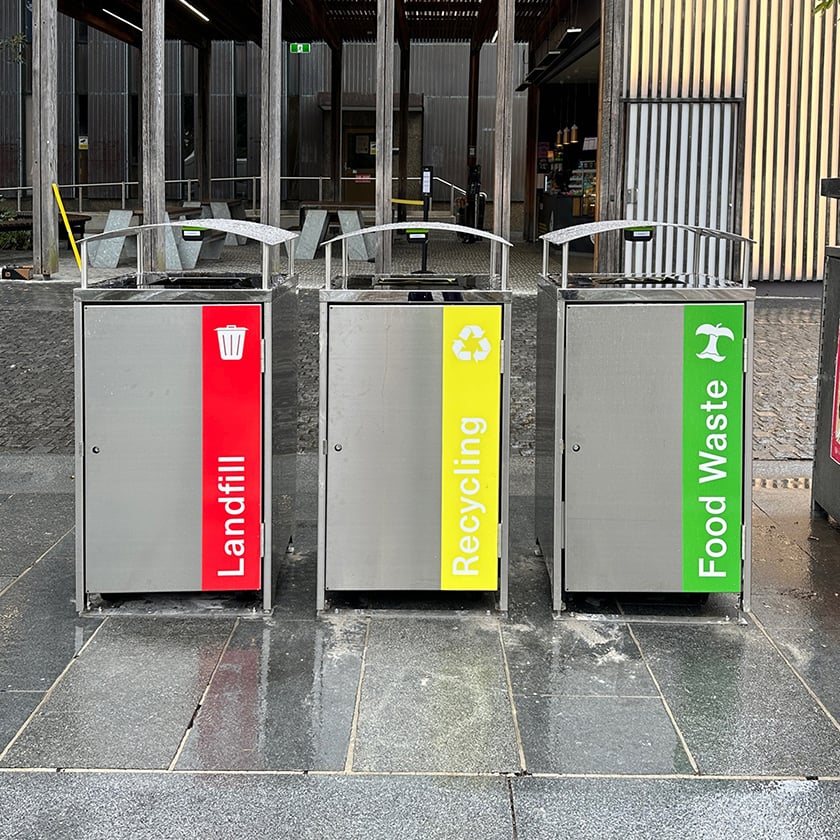
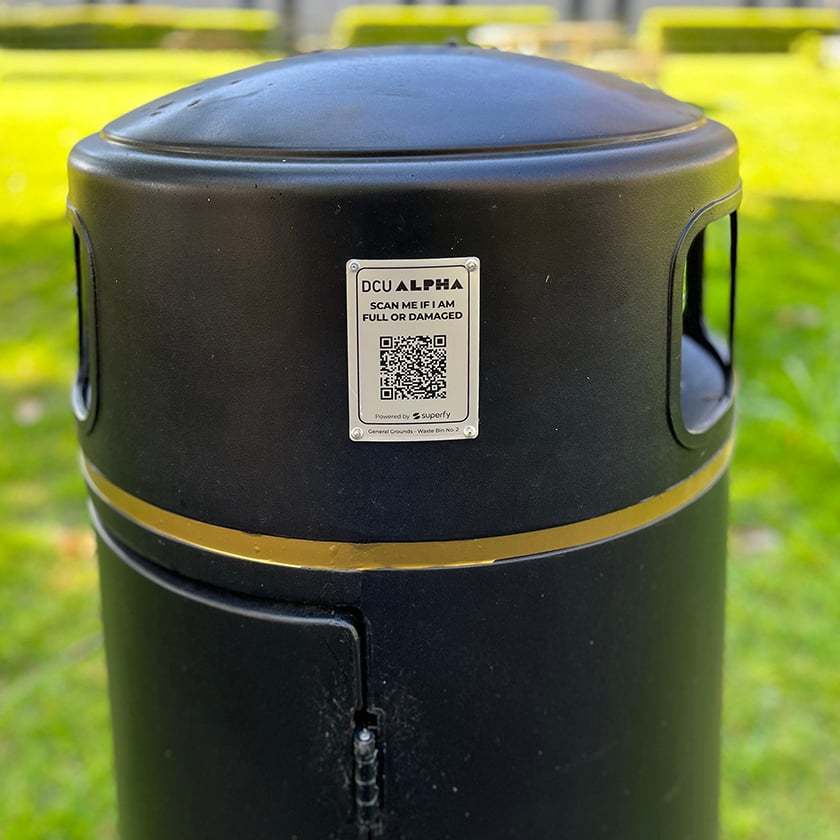
Residence halls compete for recycling rates. Digital screens show real-time diversion stats. Students scan QR codes to report issues and earn sustainability points. Make waste reduction a visible campus movement.
Adaptive Collections Match Campus Rhythms
Automatically adjust collection frequency based on academic calendar, exam periods, events, and seasonal patterns. Never collect empty bins during reading week or miss overflows during move-in.
Reduce Contamination with Smart Feedback
Optical Sensors detect contamination. Digital screens provide instant feedback. Real-time education reduces contamination from 40%+ to under 15%.
Unified Campus-Wide Visibility
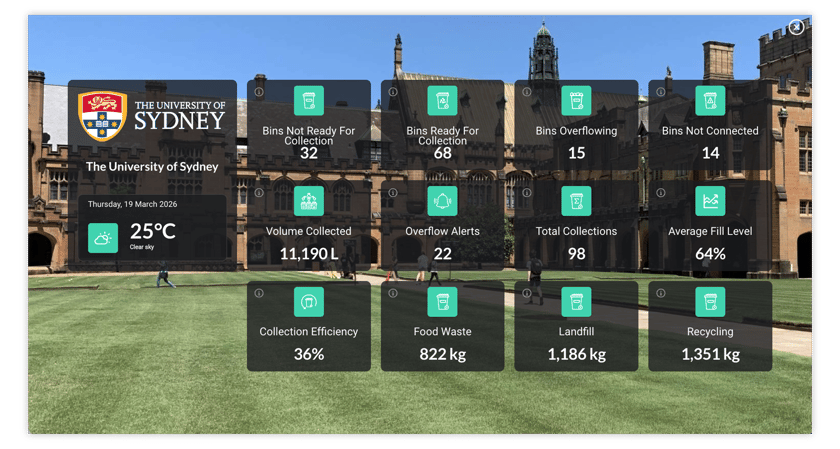
One dashboard shows waste generation across residence halls, academic buildings, athletics facilities, dining halls, and events. See which buildings are hitting targets and which need intervention.
Residence Hall Zero Waste Competition
Challenge
Major Australian university with 12 residence halls wanted to improve recycling rates but students largely ignored waste sorting. Contamination rates over 45% meant most recycling went to landfill. Facilities had no data on which halls were performing well.
Solution
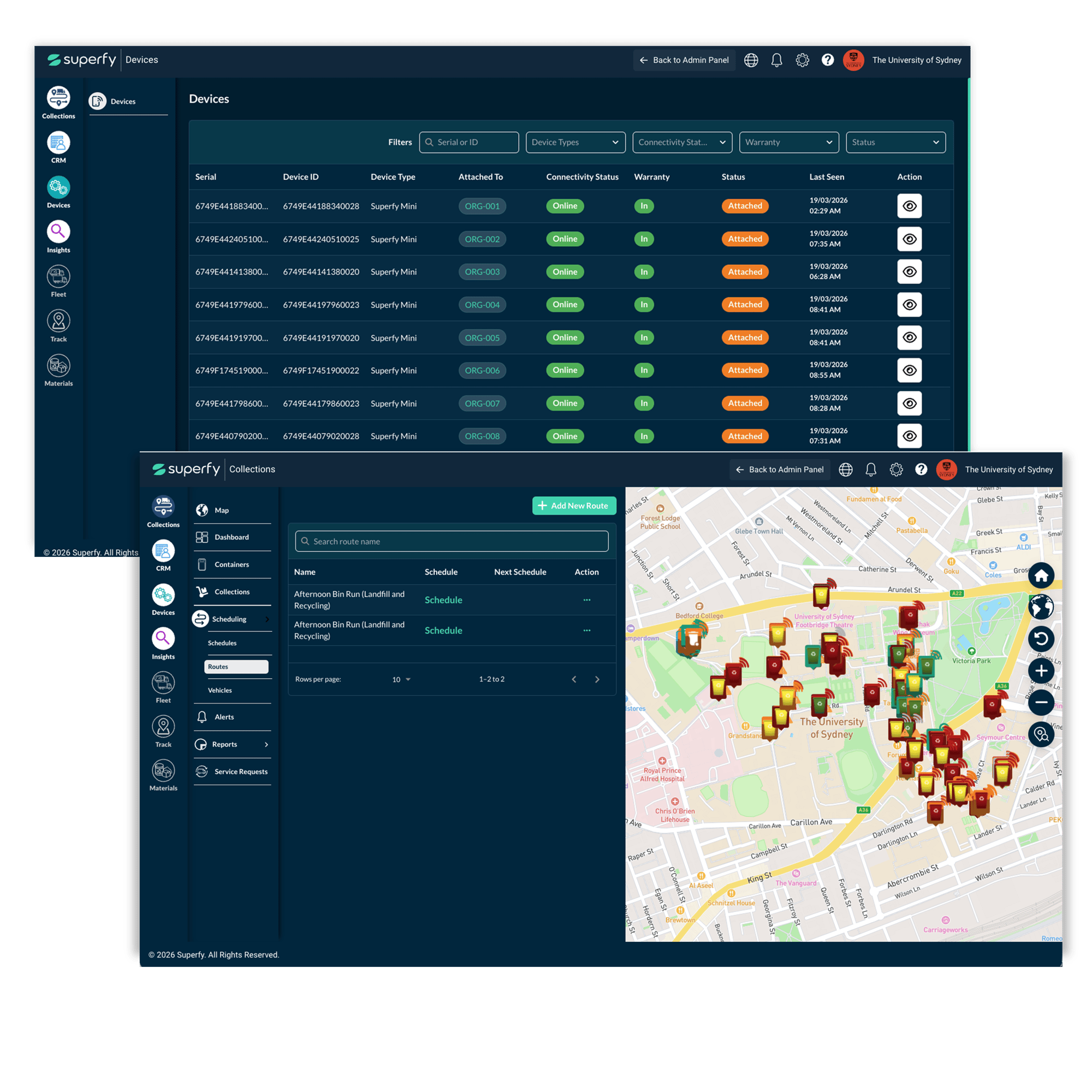
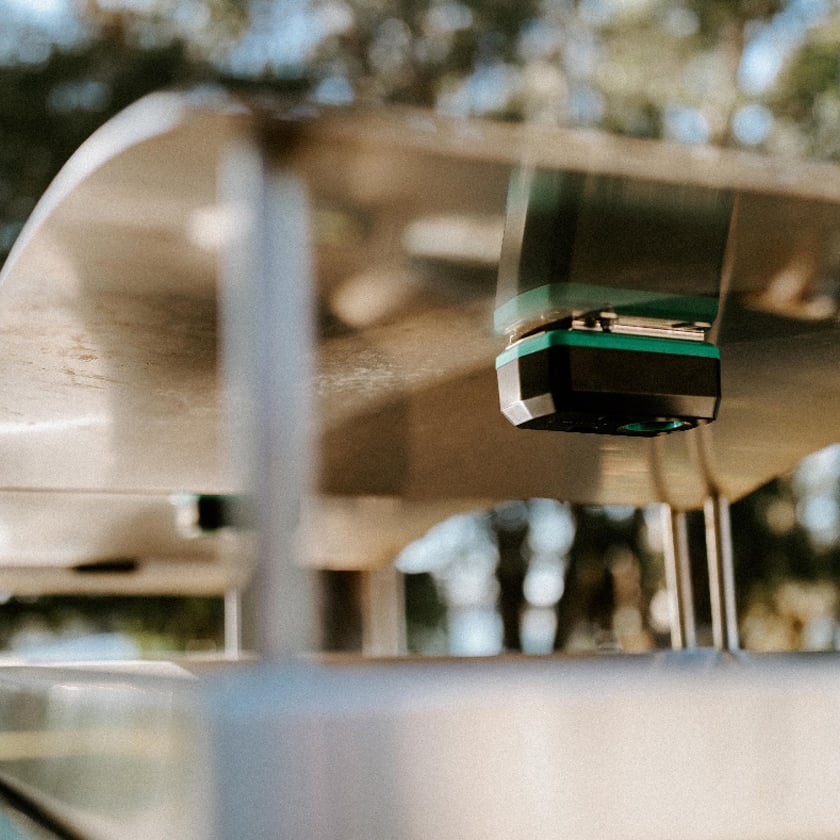
Deployed Superfy Track sensors in every residence hall with building-level dashboards visible in common areas. Launched semester-long competition: "Which hall can achieve highest diversion rate?" Real-time leaderboards updated daily. Winners got sustainability grants for hall improvements.
Result
Student engagement jumped from 30% to 78%, contamination dropped from 45% to 18%, campus-wide diversion improved from 38% to 64%, students requested expansion to academic buildings, program became recruitment marketing tool.
Smart Event & Athletics Waste Management
Challenge
University stadium with 25,000 capacity generated mountains of waste during football games and concerts. Fixed bin placements led to overflows in some areas, empty bins in others. Cleaning crews collected everything post-event with no visibility into what needed attention.
Solution
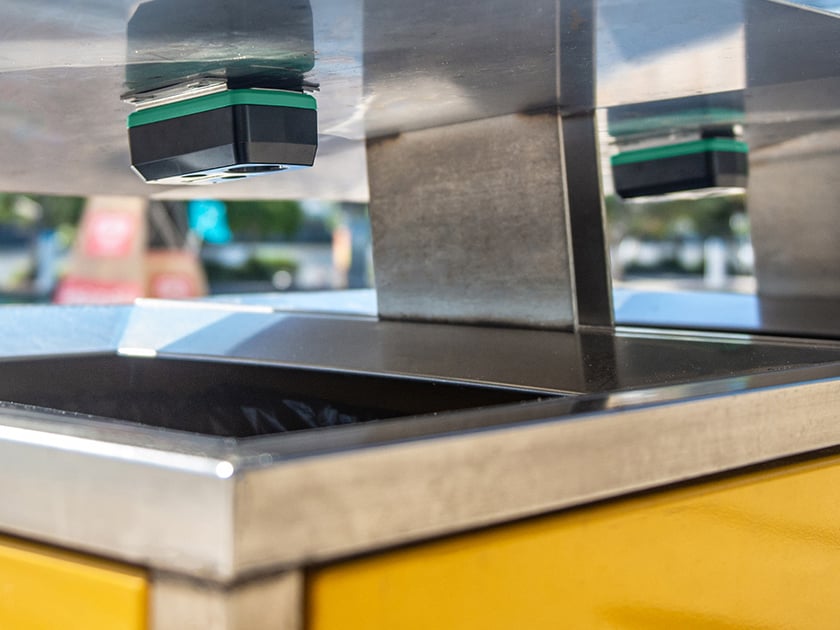
Mobile smart bins deployed strategically based on crowd flow predictions. Fill-level monitoring shows real-time status during events. Cleaning crews receive alerts about which areas need attention. QR codes allow event staff to request emergency bin swaps.
Result
60% reduction in overflow incidents during games, cleaning time reduced from 4 hours to 2.5 hours post-event, waste diversion at events improved from 22% to 58%, significant cost savings on event staffing.
Academic Building Optimization During Term Changes
Challenge
40 academic buildings with wildly different usage patterns. Engineering and science labs generated waste year-round. Arts buildings were quiet in summer. Business school spiked during MBA intensive periods. Fixed daily collections wasted resources.
Solution
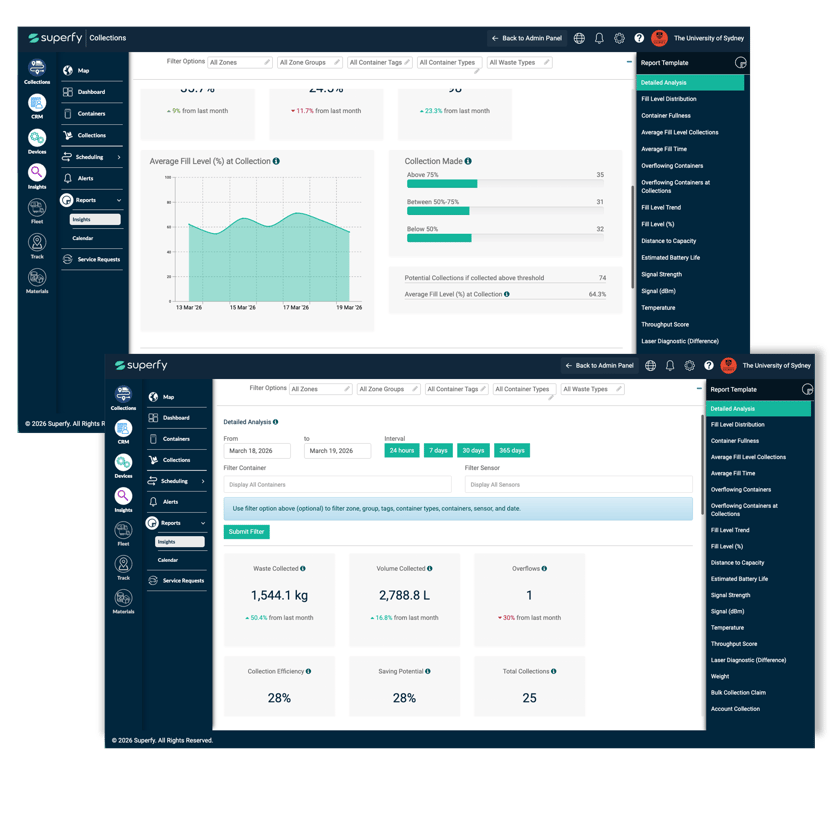
Superfy Collections schedules adapted automatically based on fill levels and academic calendar integration. During summer, many buildings moved to twice-weekly collections. During exam periods, high-traffic buildings got twice-daily service.
Result
42% reduction in unnecessary collection trips, fuel savings of £85K annually, cleaning staff redeployed to deep-cleaning projects during low-volume periods, eliminated complaints about overflowing bins during peak periods.
Dining Hall Organics Diversion Program
Challenge
Five campus dining halls committed to composting all food waste but had no visibility into volumes or contamination. Students frequently put plastic cutlery and packaging in organics bins, contaminating entire loads.
Solution
Smart bins in dining halls with screens showing real-time feedback. When contamination detected, screen displays an immediate prompt. Superfy Materials tracks food waste volumes by dining hall and meal period.
Result
Organics contamination from 38% to 9%, composting 180 tonnes annually (previously 65 tonnes), dining services used data to reduce food waste through portion adjustments, students received campus sustainability awards.
Move-In/Move-Out Waste Prevention
Challenge
University with 8,000 residence students generated 150+ tonnes of waste during move-out week. Mattresses, furniture, clothing, electronics—most went to landfill. Students had no easy way to donate or recycle items.
Solution
QR codes posted throughout residences during move-out period. Students scan to schedule pickup for donations (clothing, furniture, books), electronics recycling, or bulk items. Superfy Materials tracks what goes to reuse vs recycling vs landfill.
Result
Move-out waste reduced from 150 tonnes to 62 tonnes, diverted 88 tonnes to donation/reuse, recovered £45K worth of resellable furniture and electronics, student satisfaction with move-out process improved dramatically.
University of Sydney
"The visibility Superfy provides has been transformational. We can now see which buildings, which meal periods, even which specific bin locations have contamination issues. This granular data allows us to target education and improve infrastructure strategically rather than guessing."
Superfy Products for Universities

Superfy Collections
-
QR codes for student self-service requests
-
Automated scheduling adapted to term schedules
-
Special event waste management
-
Move-in/move-out bulk collection
-
Student portal for sustainability tracking

Superfy Track
-
Fill-level sensors for indoor and outdoor bins
-
Real-time dashboards for building administrators
-
Public displays for student engagement
-
Contamination detection and alerts
-
Usage pattern analysis by academic calendar

Superfy Product Passport
-
Waste stream tracking by building and department
-
Residence hall competition leaderboards
-
Food waste measurement for dining services
-
Donation and reuse tracking
-
Comprehensive ESG reporting for administration
Campus Engagement Features
-
Gamification: building vs building competitions
-
Real-time impact displays in common areas
-
Student sustainability points and rewards
-
Mobile app for reporting issues
-
Integration with campus sustainability courses
The Business Impact
Hit Ambitious Sustainability Targets
Typical campuses improve diversion rates from 40-45% to 65-75% within 2 years with data to prove progress.
Reduce Operational Costs 30-40%
Stop collecting empty bins. Typical university saves £250K-£400K annually in labor and vehicle costs.
Student Recruitment & Retention
Gen Z students choose universities based on sustainability credentials. Visible smart waste programs become powerful recruitment marketing.
Administration & Donor Reporting
Automated ESG reporting with granular data satisfies administration requirements and impresses sustainability-focused donors.
FAQ
How do we handle student vandalism or sensor theft?
Sensors are tamper-resistant and most campuses see minimal issues—students respect sustainability infrastructure. When damage occurs, you get instant alerts. Most universities find students actually protect the bins because they're invested in the competition results. Insurance/replacement costs average under £2K annually even for large campuses.
Can we integrate with our existing campus sustainability reporting?
Yes. Superfy exports data in formats compatible with STARS (Sustainability Tracking Assessment & Rating System), AASHE reporting, and custom university dashboards. We can push data directly to your sustainability office's systems.
What about data privacy for residence halls?
We track building-level data, not individual students. Residence hall competitions show aggregate building performance. No personal data collection ensures FERPA/privacy compliance. Students opt-in to point systems voluntarily.
How do we handle the seasonal nature of campus operations?
System learns patterns automatically. After one academic year, it predicts reading weeks, exam periods, summer sessions, and breaks. You can also manually adjust collection frequencies for known events like homecoming or graduation.
What about Greek houses, off-campus housing, or satellite campuses?
Superfy works anywhere. Greek houses love competitions between houses. Off-campus student housing complexes can participate in university-wide initiatives. Satellite campuses get same visibility as main campus. Flexible deployment adapts to your institutional structure.
Find out more about Superfy Solutions